Categories
1959 buildings history

Reading My Way Through 1959

I’m planning to spend 2019 reading only novels from 1959, with some extra homework on the side.

Why? Because in 2017, I set myself a similar reading challenge – only books by women – and it helped me focus. I read more, and more widely, and more books that were new to me. I discovered some new favourite writers (such as Edna O’Brien) and the habit stuck: I continued to read more books by women in 2018, and feel better for it.

But in 2018, with no specific challenge, I read less overall, and caught myself lazily returning to old favourites out of which I have already chewed all the flavour.

So, for this year, I needed a challenge, and focusing on a specific time period seemed like a good idea. The mid-20th century happens to be where my head is at a lot of the time anyway. It also happens to be when the Big Novel I’m working on is mostly set, so this also doubles as research.

I landed on 1959 specifically by asking my handful of discerning Twitter followers to choose between 80 years ago, 70, 60, and 50. (It was close – 1969 nearly won.)

As of this morning, I’ve started reading Free Fall by William Golding, which I found on Wikipedia’s list of British novels published in 1959, and then happened to stumble across in a secondhand bookshop in Osterley on Sunday. “Perhaps you found this book on a stall fifty years hence which is another now”, he writes eight pages in, bending my mind somewhat, despite being ten years out. It’s not quite my usual thing – very self-consciously literary, prose verging on Joycean – but it seems to have hooks in me already.
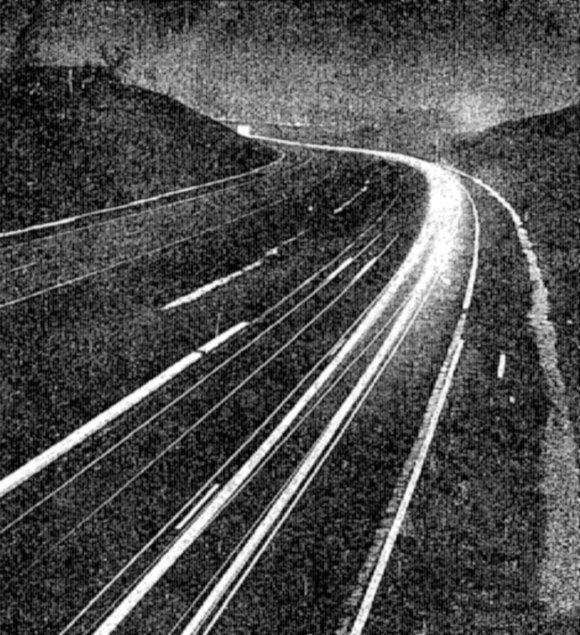
A low resolution image of streaks of light on a curving road.
From the front page of the Manchester Guardian for 1 January 1959: ‘The lights of south-bound vehicles on the Preston Motorway’.

On the side, though, I’m also going to try to do something I’ve been thinking about for years: reading a daily newspaper for each day of 1959.

This has never been easier than today with local libraries offering access to The Times and the Guardian, and the incredible British Newspaper Archive providing scans of all kinds of local and national titles.

On 1 January 1959 the Manchester Guardian was declaring A PROSPEROUS NEW YEAR with “Industrial shares index at highest level ever”. It reported that actor Alec Guinness had been awarded a knighthood, and that the West had rejected Nikita Khruschev’s suggestion that Berlin be made a “free city”. Meanwhile, in Cyprus, EOKA issued a defiant new year message for the British government: “We will emerge from our present peaceful attitude as FULLY armed avengers to return the blows.”

Postcard of Coventry Cathedral.

Given my interest in post-war architecture, I was also interested to read this:

To-day, for the first time, hymns and prayers have sounded in Coventry’s new cathedral. They came not from the choice and chapter but from the unaccustomed voices of the masons and labourers, tilers and glaziers and plumbers, whose hands are raising the walls of what to-oday we heard called “This great fortress of God in Coventry.”

Unfortunately, an opinion piece on racial tension, and a surge in white nationalist tendencies, suggests that there’s little shelter from the problems of 2019 to be found in desk-bound time travel.

I’ll also be making a point of listening to music from 1959, and watching films and TV from the same year, without being exclusive about it. I’m looking forward to rewatching Room at the Top for starters, which I last saw as a teenager in Steven Bennison’s media studies class at Bridgwater College.

If anyone feels like joining in, or borrowing this idea but wallowing in a different year, go for it – I always enjoy company on these expeditions.

Categories
buildings concrete history Somerset

War Still Echoes

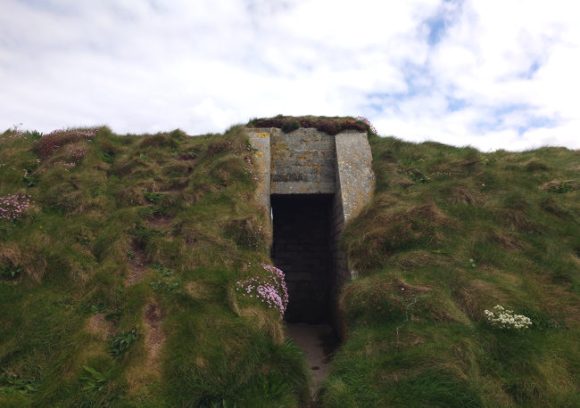
Inside a shelter.
The Spitfire base at Perranporth, Cornwall.

The recent surge in the visibility of fascism and fascist imagery is depressing. It’s become a cliche to say it but here goes: we had a war and settled this a while back, didn’t we?

What I’ve been thinking about lately, in particular, is how that ‘while back’ doesn’t even feel all that far back.

Yes, that feeling is partly a result of my being a relic of the 1970s but, really, you don’t have to look far, even in the leafy suburbs, small towns and countryside of Britain, to see great concrete chunks of World War II just lying around, like tombstones.

I went for a run up and around Purdown in Bristol the other day. My aim was to get to the base of the telecoms tower I’ve been able to see on the horizon for the last few weeks. Once I’d got past that, however, I was amazed to find myself picking a path through what were obviously the overgrown remains of gun emplacements.

Officially known as the Purdown Heavy Anti-Aircraft Battery this site was first militarised in 1939 and the concrete structures were erected in 1940. Locally it was the source of the legend of ‘Purdown Percy‘, a supposedly secret, supposedly massive gun that could be heard across the city.

Fantastic as I found this survival I wasn’t surprised by its existence because, honestly, it sometimes feels like a challenge to go for a walk or ramble without stumbling across something like this.

Spitfire base, Perranporth.

On the Cornish coast in April my other half and I found ourselves diverted through the remains of a Spitfire base at Perranporth — overgrown, yes, but so complete that a Battle of Britain fighter squadron could probably operate out of it by this time next week if need be.

In my home town of Bridgwater pill boxes surround the railway station and line the canal all the way Taunton — brutal brick and concrete structures designed for no purpose other than war and preserved at first, I’ve always assumed, because no-one quite believed the peace would hold with Russia rampant; and then just forgotten about.

Even in London, built on and overbuilt and developed to a high shine, you can still see painted signs on Smith Square pointing to air raid shelters, and the remains of shelters themselves in parks and on side streets. Just look at the Citadel in St James’s Park, as I used to do on the way into work most mornings for about a decade — a bunker so bullying and intrusive, like a beached warship, that it has almost become invisible.

The war is still with us, even as those who remember it firsthand slip away from us.

The war is still The War.

The warning still rings.

Categories
buildings history

It’s In Swindon

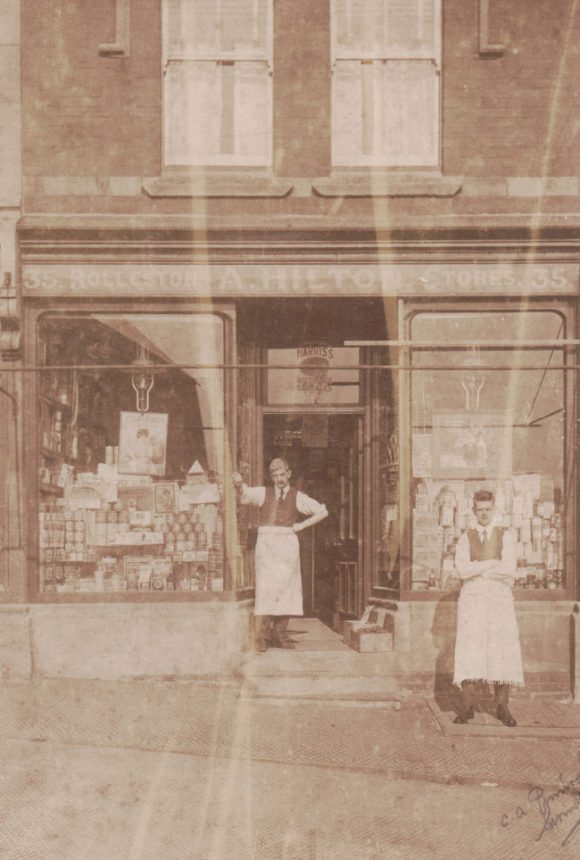
Edwardian photograph: a grocer's shop.

I have a skill that I have yet to work out a way to monetise: finding places on Google Street View based on a single photograph and limited data.

You know when some account or other Tweets a black-and-white photo with some variant on, ‘Any idea where this is, Twitter peeps?’ Once I’ve finished vomiting over the use of ‘Twitter peeps’, I’m the bloke that spends an hour switching between Street View, census records, online photo archives and about 60 other sources to work it out.

It reminds of a jigsaw puzzle based on an M.C. Escher drawing I once helped the other half with. All the pieces looked the same, it seemed utterly impossible, but slowly we learned to distinguish between mostly black, cross-hatched black, sideways hatched dark grey, stippled dark grey, and so on. With an old photo, the more you stare, the more details pop out — a church spire in the background, a number on a nearby shop, the name of a brand of horse food, a faded sign…

Only this morning I cracked a puzzle set by the ever-fascinating @ghostsigns by spotting a war memorial in the bottom right corner; searching the Imperial War Museum’s war memorial database for NEWCASTLE UNDER LYME OBELISK and then exploring the area around Chesterton Park (where I’ve never been in real life) on Street View.

It’s satisfying on several levels. First, it’s pleasing to help someone else. Secondly, as someone who often wants help from others solving pub-related mysteries, I hope it earns me some Karma or something. Then there’s the pleasure of the hunt — I didn’t know anything about Newcastle-under-Lyme when I got up this morning, but now I feel as if I’ve lived there. Finally, there’s the reason most people do puzzles: the sense of elation that comes with a deferred resolution. I may have punched the air discreetly over my porridge.

My greatest triumph came closer to home a couple of years ago. The photo at the top of this post is of my partner’s great grandfather. We knew he ran a grocer’s shop in East London between the wars on a particular street (Orford Road, Walthamstow) but couldn’t work out where it was exactly. I stared at that picture, at Street View, back at the picture, back at Street View, until hours later I declared, ‘It’s in Swindon. Here, look.’

See, Orford road doesn’t slope, I eventually remembered, which broke that hang up. Then, free to think beyond what I’d assumed was an established fact, I started to look more widely, starting by Googling ROLLESTON which, among other things, is a street in Swindon. That rang a bell — wasn’t that where the other half’s great-grandmother was born? I trolled up and down Rolleston Street for a bit but couldn’t find the shop. Then I zeroed in on this distinctive feature:

Window bracket

I’d seen this, here. But the window arrangement wasn’t quite right, and none of the other buildings nearby had the same arrangement. Then, the final move: I looked at the building from a different angle and found a shot from an older Street View survey: BINGO, THERE IT IS.

That’s clearly a converted shop premises, on a slope, with the right arrangement of windows and brackets. (I didn’t know then about the back-and-forward date slider in Street View, or maybe it hadn’t appeared at that point.)

I know, I know — this is incredibly bloody boring. That’s who I am. Deal with it. And if you get stuck with something like this, do drop me a line. I might be able to help and even if I can’t I’ll have fun trying.