
What if the bearded hippy vicar who used to guest star at my school assemblies had to deal with the events of The Exorcist? That simple question was the seed for this story.
The vicar who came to my school wasn’t called Paul but he did have a beard and an acoustic guitar. He was a Cambridge graduate and softly well spoken.
And his church on the estate was a post-war modernist building, with concrete columns and parquet floors, at which I attended harvest festivals, christenings and weddings.
But I can’t say that my character of Father Paul is ‘based’ on this real vicar because when I knew him, I was a child – and not one who regularly went to church.
In other words, Father Paul is a creation inspired by memories of vague impressions.
The main thing I took from the real vicar is the title ‘Father Paul’. Because our vicar was always called ‘Father…’ even though he was Church of England.
When I shared drafts of this story with various critical friends, a couple picked me up on this detail, thinking they’d found a mistake. But (a) that’s how it was and (b) it turns out lots of CoFE vicars get called ‘Father’ informally; some dislike it, most don’t.
Also in the mix was (and I might almost say ‘as ever’) the Enfield poltergeist, the classic working class English haunting. Chris Coates has written a pleasingly snarky debunking of the Enfield case.
Personally, I don’t believe for one moment that anything supernatural happened in that particular house.
For this story, I asked myself, how would an unequivocally real poltergeist case look and feel? What would need to happen for somebody level-headed to really believe in what they were seeing?
And how might a cunning demon or devil go about denying an exorcist documentary evidence of the facts as part of its mischief?
Finally, as I’m sure many people will notice, there’s a touch of a famous British folk horror film here, too, which I won’t name because it would probably constitute a spoiler to do so.
When you’ve read the story, let me know if you’ve worked out which film I mean.
More generally, the landscape of Bristol, and of my hometown, both of which were urbanised rapidly after World War II, continues to inspire me.
Concrete laid over old orchards. Council houses on hills and in valleys with who knows what beneath the mud.
Place names borrowed by local government officials from those of farms, fields, lost manor houses, and other landmarks otherwise wiped from the map.
How many exorcisms do we need?
I’m very conscious that poltergeists and exorcisms might be played out, or at least hard to find new approaches towards.
In this case, I hope that the setting (an English council estate), the quirk of a non-Catholic exorcist, and the streak of folk horror, might make it feel fresh.
Having said that, for more in a similar vein, I recommend The Borderlands, a somewhat successful 2013 film about Catholic priests sent to exorcise a church in Devon.
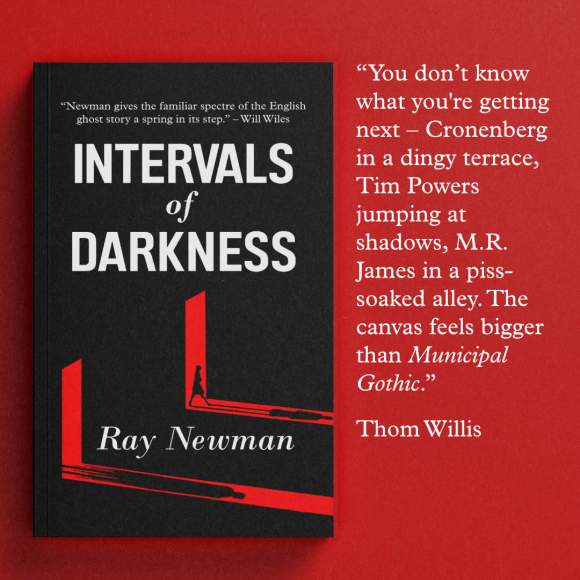
Intervals of Darkness will be published on 7 September. You can pre-order the eBook now.

 Precast Reinforced Concrete Heart